Are goods inspected before shipment?
Most defects are noticed only in Europe — when a complaint from 10,000 km away is too expensive and slow. Pre-shipment inspection stops that.
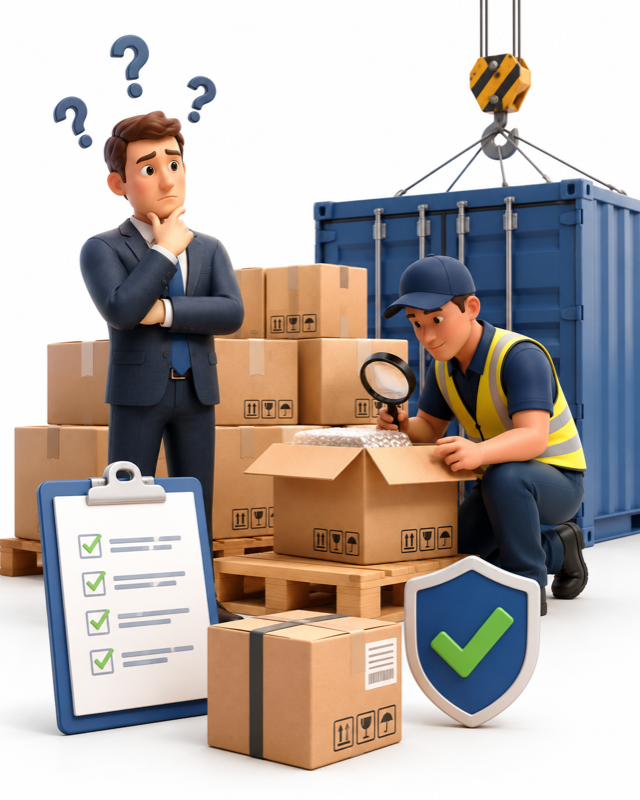
The risk: paid for is not the same as delivered
Most damages in China imports do not arise during supplier selection, but at delivery: wrong quantities, damaged packaging, components swapped for cheaper alternatives, missing labels, wrong model numbers, water damage in the warehouse. Once the goods are in the container heading for Europe, it's too late — complaints from 10,000 km away are tedious and mostly unsuccessful.
A pre-shipment inspection (PSI) per ISO 2859-1 (statistical Acceptable Quality Level / AQL) is industry standard — yet many importers skip it to save €300–500. The follow-up costs of a defective shipment exceed this "saving" by a factor of 50–500.
How a professional pre-shipment inspection works
1. Timing
PSI is performed after production completion and before container loading — typically when 80–100% of the order is ready. Too early = nothing checked; too late = ship has already left.
2. Sample size per AQL standard
Sample size follows ISO 2859-1: for 1,001–3,200 units, 50 inspection units must be checked. AQL levels: Major defects 2.5 (max 3 of 50 may have major defects), Minor 4.0. On exceedance, the shipment is rejected.
3. Function tests
For electrical devices: voltage test, insulation resistance, function check. For mechanical products: stress test, dimensional measurement with caliper. For furniture: stability test, material authenticity (plywood vs. MDF). Tests are documented with photo + measurement protocol.
4. Packaging inspection
Cartons (compression test, correct markings), inner padding, labelling (correct barcode? correct language? EU markings?), palletization (suitable for container transport?), enough desiccant?
5. Document check
Packing list matches order? Commercial invoice correct? Certificate of origin (Form A or FORM E)? Phytosanitary certificates for wood/plants? MSDS for chemicals? Declaration of Conformity enclosed?
6. Container loading inspection
Optional but recommended: we supervise the loading ourselves. This ensures the inspected goods are actually loaded — not a different (substandard) batch from the warehouse.
Common defects in pre-shipment inspections (industry data)
- 10–20% major defect rate in non-pre-inspected furniture production (loose screws, wrong hardware, scratches).
- 15–30% function defects in cheap electronics without documented QC process.
- 5–15% packaging defects — wrong labels, missing instructions, damaged inner cartons.
- 2–8% complete-swap — sample before order was different material/model than mass production.
Sources: Quality Inspection industry reports, own audit data from Chengdu & Shenzhen.
Consequences if ignored
- Complaints from EU = very expensive — return shipment by sea: €3,000–€6,000 per container plus customs problems.
- Supplier delay tactics — Chinese suppliers rarely acknowledge defects from 10,000 km away. "We need to check" for weeks.
- Customer complaints — if defects pass through to the EU end-customer, recall + reputational damage threaten.
- Loss of warranty claims — accepting goods without objection counts as acceptance; defect notice must occur within statutory deadlines (CISG Art. 39).
- Insurance problems — transport insurance does not cover pre-existing production defects.
Sources & further reading
- ISO 2859-1 — Sampling procedures (AQL standard for sampling inspection)
- CISG — UN Sales Law (UN Convention on Contracts for the International Sale of Goods)
- Quality Inspection Blog — practical guides
- SGS Quality Monitoring
- Intertek Inspection Services
Ready to check this risk?
On-site in China, we do what remote audits cannot: physical verification, original documents, court-proof photo reports.