Do certificates match the product?
Certificates often look official — but they may be for other products or forged. How do you verify that a certificate actually applies to the product you ordered?
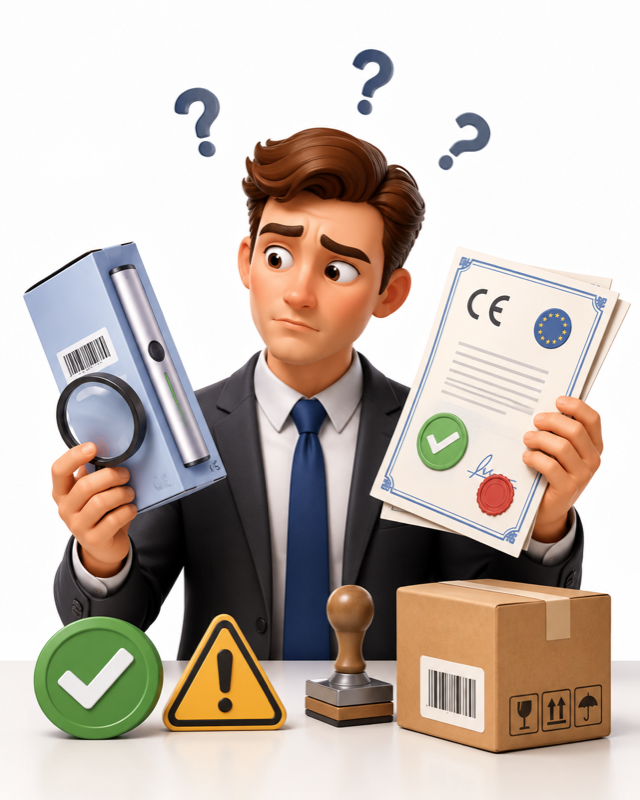
The risk: certificates for other products or forged
A common trick: the supplier shows a CE certificate, an ISO 9001 certificate, or a TÜV test report — but this certificate was issued for a different product, a different model, or a different production site. At first glance, everything looks correct. On closer inspection, product description, model number, manufacturer address, or validity period don't match your order.
The EU early-warning system Safety Gate reports hundreds of such cases annually, in which importers were caught with forged or repurposed certificates — and then stopped by market surveillance.
How we check certificate fit
1. Accreditation verification
Every genuine certificate carries an accreditation number from the issuing body. This can be checked against the European Accreditation (EA) Database or the ILAC Signatory Database. Chinese accreditations are at CNAS (China National Accreditation Service).
2. Direct query to the issuing body
We contact the issuing body (TÜV, DEKRA, SGS, Intertek) directly with certificate number + receiving company name. Genuine bodies respond within 24–48h. With forged certificates, there's either no response or the body confirms: "This number does not exist."
3. Product-to-certificate match
We check: does the product description in the certificate match the order? Model number? Serial range? Manufacturer address? Production site? Validity date? Applicable standards (e.g., EN 60335 for electrical devices, EN 71 for toys)?
4. Audit trail for OEM products
If the supplier offers an OEM/ODM model (manufactures for other brands), we check whether the certification is transferable. Some certificates apply only to the brand holder. You may need your own conformity assessment.
5. CE mark vs. China Compulsory Certificate (CCC)
Warning: CCC (China Compulsory Certificate) is not CE. CCC is the Chinese domestic certification. Many suppliers show CCC certificates and imply they apply to the EU — they don't. See DEKRA on CCC certification.
Consequences if ignored
- Customs stop — EU customs cross-checks certificates against the TARIC database. On inconsistencies, the shipment is detained (see EU TARIC).
- Fines — false CE marking counts as market fraud. Six-figure fines are common in DACH countries.
- Recall obligation — if the goods are already on the market, you must recall them at your own cost.
- Criminal exposure — knowingly placing products on the market without valid certification is a criminal offense under Austria's PMG (Product Safety Act).
- Insurance exclusion — product liability insurance does not cover knowingly false certification.
Sources & further reading
- European Accreditation (EA) — EU accreditation database
- ILAC Signatories — international accreditation lookup
- CNAS — China National Accreditation Service
- EU CE-Marking Guide — official Commission explanation
- TÜV certificate database
Ready to check this risk?
On-site in China, we do what remote audits cannot: physical verification, original documents, court-proof photo reports.